
Planning an event on a tight timeline can feel overwhelming—especially when food is involved. Whether it’s a sudden celebration, a work function that came together quickly, or unexpected changes to your original plans, last minute catering happens more often than people admit. The good news? It doesn’t have to mean chaos, bland menus, or a stressful experience.
With the right approach, you can still pull off a seamless, flavorful event. This guide walks you through exactly how to handle last minute catering with confidence—while also showing why planning ahead is still the gold standard for a truly elevated experience.
Yes, Last Minute Catering Happens—And It’s Completely Okay
Life doesn’t always follow a perfectly planned timeline—and your events won’t either.
There are plenty of valid reasons why catering might come together at the last minute:
- A venue suddenly becomes available
- Guest counts increase unexpectedly
- Another caterer cancels or falls through
- A casual gathering turns into a full celebration
- Corporate decisions happen quickly
Here’s the key takeaway:
Last minute catering isn’t a failure—it’s a situation that simply requires smarter, more flexible decision-making.
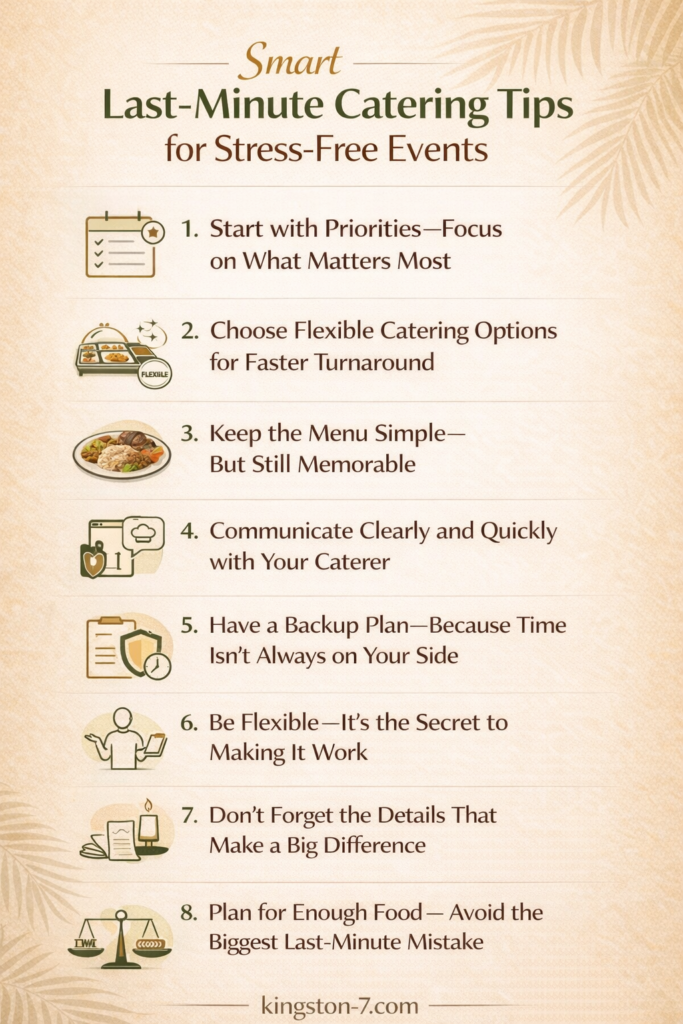
Smart Last Minute Catering Tips for Stress-Free Events
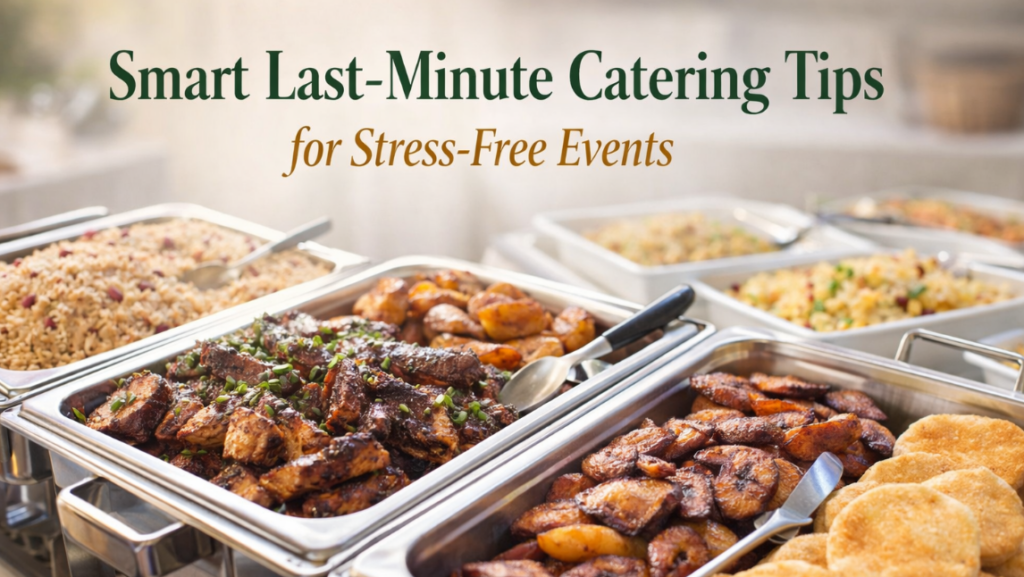
When time is tight and expectations are high, catering can quickly become the most stressful part of planning an event. The good news is that last minute doesn’t have to mean disorganized. With the right approach, smart decisions, and a clear plan, you can still deliver a smooth, flavorful, and memorable experience for guests.
1. Start with Priorities—Focus on What Matters Most
When time is limited, clarity becomes your best tool.
Instead of trying to create the “perfect” event, focus on what truly matters:
- Guest satisfaction: Will everyone be well-fed and happy?
- Food quality: Is the menu still flavorful and well-prepared?
- Service reliability: Will everything arrive on time and as expected?
Ask yourself:
- What’s non-negotiable? (e.g., hot food, dietary needs, cultural dishes)
- What can be simplified? (e.g., plated service vs buffet)
Pro tip: A simplified plan executed well always beats an overly ambitious plan done poorly.
2. Choose Flexible Catering Options for Faster Turnaround
Not all catering styles work well under time pressure.
If you’re short on time, prioritize options that are easier to execute:
- Drop-off catering: Quick, efficient, and ideal for casual or semi-formal events
- Buffet-style service: Requires less coordination than plated meals
- Pre-set menus: Faster than fully customized options
Avoid:
- Highly complex, multi-course plated dinners
- Extensive menu customization with specialty sourcing
Why this matters:
Flexible catering options allow kitchens to maintain quality without rushing or compromising standards.
3. Keep the Menu Simple—But Still Memorable
A shorter timeline doesn’t mean you have to settle for boring food.
Focus on:
- Signature dishes that are proven crowd-pleasers
- Balanced menus with protein, sides, and vegetarian options
- Bold flavors that make an impression without requiring complexity
For example, Jamaican cuisine naturally lends itself to last-minute success:
- Flavor-rich marinades
- Slow-cooked dishes that hold well
- Sides that complement multiple main courses
Smart move: Choose dishes that are both impactful and efficient to prepare.
4. Communicate Clearly and Quickly with Your Caterer
When time is tight, miscommunication is your biggest risk.
Be upfront and direct about:
- Event date and time
- Guest count (or best estimate)
- Venue details and setup requirements
- Budget range
The more clarity you provide, the faster a caterer can respond with realistic options.
Avoid vague requests like:
- “We need something nice for about 50 people…”
Instead say:
- “We need buffet-style catering for 50 guests this Saturday at 5 PM, with at least one vegetarian option.”
Clarity speeds everything up.
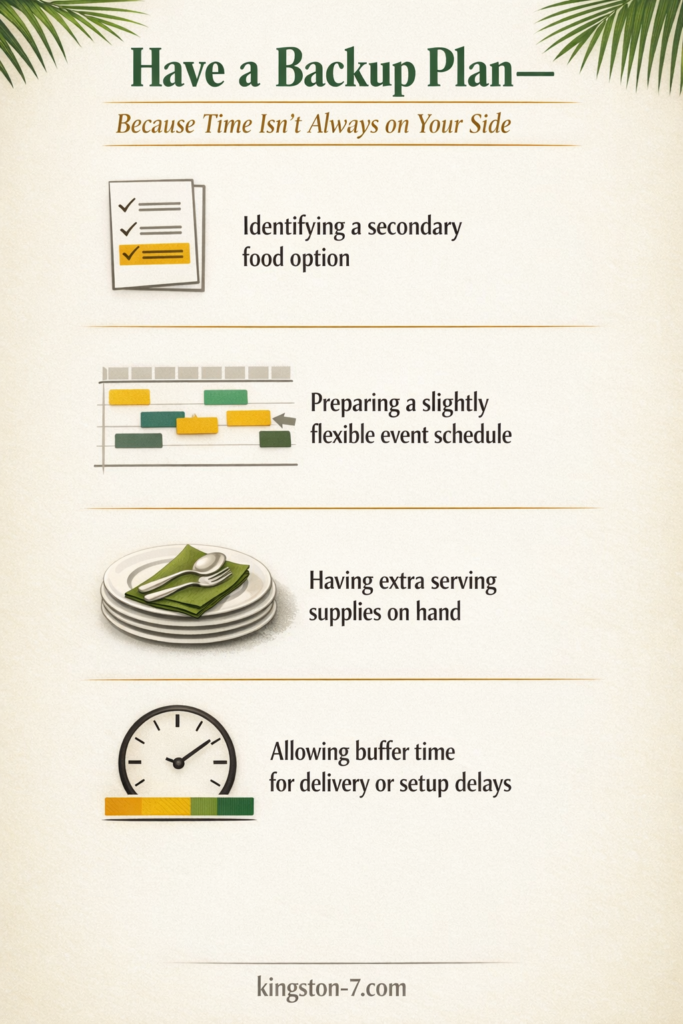
5. Have a Backup Plan—Because Time Isn’t Always on Your Side
Even with the best coordination, last-minute situations can be unpredictable. Having a simple backup plan ensures you’re not left scrambling if something changes at the last second.
Consider:
- Identifying a secondary food option (even simple platters or add-ons)
- Preparing a slightly flexible event schedule
- Having extra serving supplies on hand
- Allowing buffer time for delivery or setup delays
Why this matters:
A backup plan doesn’t mean expecting failure—it means protecting your event from unnecessary stress.
6. Be Flexible—It’s the Secret to Making It Work
Last-minute success depends on your willingness to adapt.
You may need to:
- Adjust your menu expectations
- Accept limited availability
- Choose from what’s realistically doable
Flexibility doesn’t mean lowering standards—it means working within what’s possible without sacrificing quality.
7. Don’t Forget the Details That Make a Big Difference
Even with limited time, small details can elevate your event.
Pay attention to:
- Serving utensils and setup
- Food labeling (especially for dietary needs)
- Timing of delivery or setup
- Portion planning
These details ensure your event feels organized—not rushed.
8. Plan for Enough Food—Avoid the Biggest Last-Minute Mistake
Running out of food is one of the most common issues in rushed events.
To avoid this:
- Always round your guest count up slightly
- Choose dishes that can stretch across servings
- Include filling sides (rice, vegetables, etc.)
Rule of thumb: It’s better to have a little extra than not enough.
9. Understand the Trade-Offs of Last Minute Catering
Let’s be honest—there are some limitations.
You may experience:
- Fewer menu customization options
- Limited availability of certain dishes
- Higher costs due to urgency
But here’s the upside:
- Faster decision-making
- Less overthinking
- A more streamlined event plan
When handled correctly, last minute catering can still feel polished and intentional.
10. Set Realistic Expectations—Perfection Isn’t the Goal
When planning on a short timeline, expectations need to shift slightly—but not in a negative way.
Focus on:
- Delivering a great experience, not a flawless one
- Prioritizing taste, timing, and guest enjoyment
- Letting go of overly intricate details
Remember:
- Guests will remember how the food tasted and how they felt
- They won’t notice minor adjustments or simplified elements
Mindset shift:
A well-executed, slightly simplified event will always outperform a stressful attempt at perfection.
Why Early Planning Still Wins Every Time
While last minute catering can work, early planning unlocks a completely different level of experience.
When you plan ahead, you get:
- Full menu customization tailored to your vision
- Better pricing and availability
- More time for tastings and adjustments
- Stress-free coordination with your caterer
Most importantly, early planning allows your caterer to:
- Source the best ingredients
- Prepare dishes with care and precision
- Deliver a truly elevated dining experience
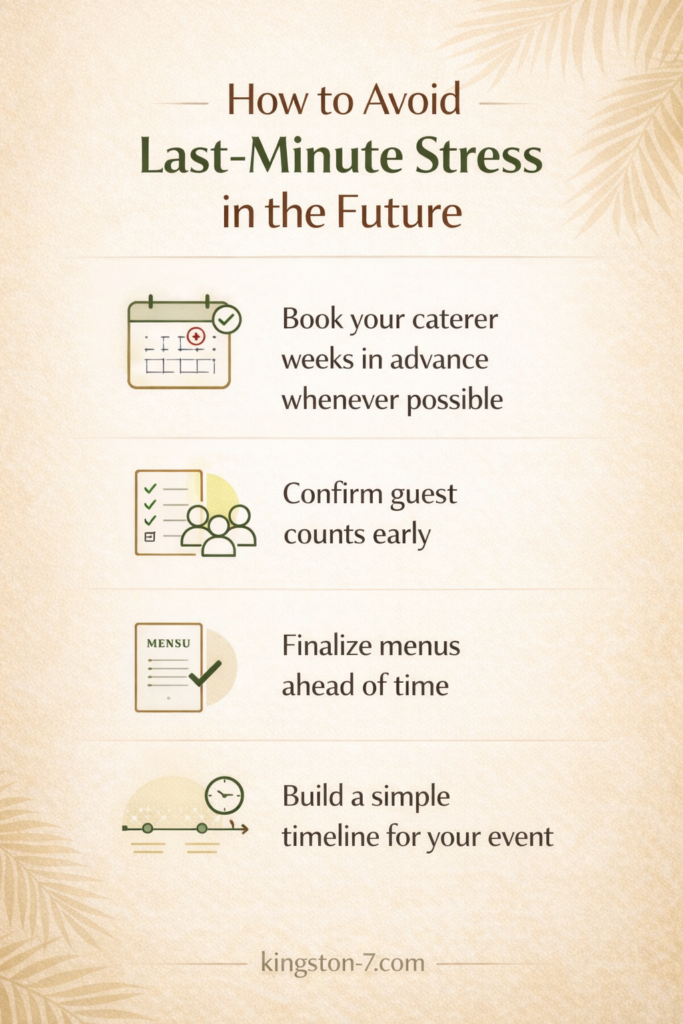
How to Avoid Last-Minute Stress in the Future
If you’ve ever experienced a time crunch, you already know how valuable preparation is.
For your next event:
- Book your caterer weeks in advance whenever possible: Securing your caterer early gives you access to better availability, more menu options, and the time needed to plan every detail without pressure. It also allows your caterer to prepare with care rather than rushing to meet tight deadlines.
- Confirm guest counts early: Having a clear estimate of your guest list helps avoid over-ordering or running short on food. Early confirmation also allows your caterer to plan portions accurately and accommodate dietary needs more effectively.
- Finalize menus ahead of time: Locking in your menu early ensures ingredient availability, smoother preparation, and a more cohesive dining experience. It also gives you the opportunity to make thoughtful adjustments rather than last-minute compromises.
- Build a simple timeline for your event: Even a basic schedule—covering food delivery, setup, service, and cleanup—keeps everything organized. A timeline ensures that your catering aligns perfectly with the flow of your event, reducing stress and confusion.
Think of it this way:
Last minute catering is a solution—but early planning is a strategy.
Make Every Event Memorable—Even on Short Notice
Last minute catering doesn’t have to mean cutting corners or settling for less. With the right mindset, clear communication, and smart decisions, you can still create an event that feels thoughtful, flavorful, and well-executed. The key is knowing where to simplify, where to stay firm, and how to work with what’s realistically possible.
And while it’s reassuring to know that great events can still come together quickly, the real magic happens when you give your catering team the time to fully bring your vision to life. That’s where experience, flavor, and true hospitality shine. If you’re planning your next event and want bold, authentic Jamaican cuisine delivered with professionalism and heart, Kingston 7 Jamaican Cuisine is ready to help you do it right—on time, every time.